

Websites
Not every domain is a website. The websites module records which of your domains actually carry a
site, and where: on the apex or on www, optionally in a subfolder, who manages it technically and
which hosting account it runs on. A website is a site at an address (klant.nl,
www.klant.nl, breik.dev/nova), so one domain can carry several: the dev installs you keep under
one domain of your own, one per client. By default a site belongs to its domain’s client, and it
can say otherwise.
Where to find it
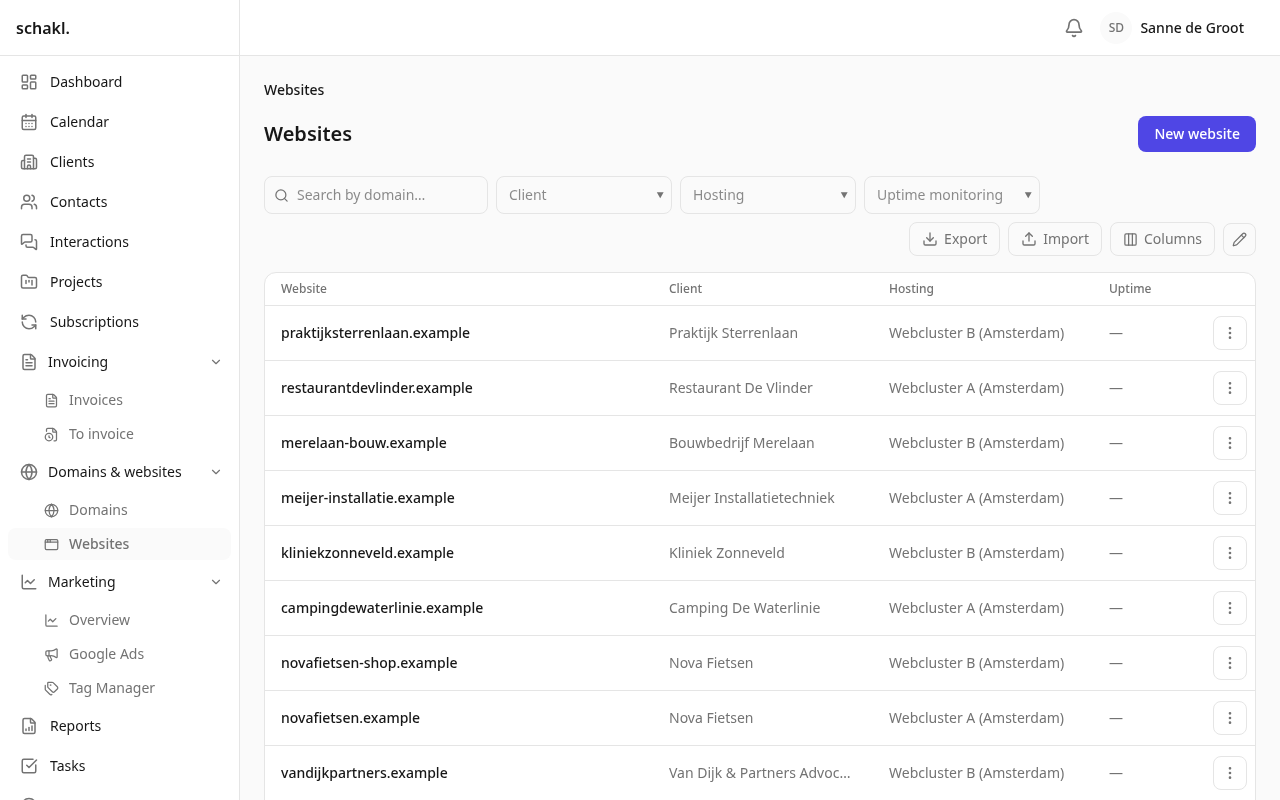
Section titled “Where to find it”In the main menu under Domeinen & websites → Websites (Domains & websites → Websites). That overview is the list; every row opens the website’s own page, with its details and below them the panels attached to it: the Abonnementen (subscriptions) that keep it online and, with the WordPress and Uptime Kuma integrations, their own cards. The domain page lists the sites on that domain, with + Nieuwe website (new website) to add one there. Each client page carries a Websites panel listing that client’s sites, their host and their hosting account.
Creating a website
Section titled “Creating a website”Because a website always hangs off a domain, creating one starts with that domain.
- Domein (Domain). The picker offers every domain, and under it says what is already on the
chosen one (“Already on this domain: breik.dev/nova”). If the domain does not exist yet, type
it in the picker: the full domain-create dialog opens and the new domain is selected for you
afterwards. Type a full address such as
breik.dev/clientand the path is filled in below. - Host.
@ (root)orwww. This is where the site lives, not where it redirects to. - Pad (Path). Empty for the root;
/folderfor an install in a subfolder. Each address holds one site: a second site at the same address is refused, naming the address. - Klant (Client). Empty means the site follows its domain’s client, which the field names. Pick another client only for a site that is not the domain’s client’s, such as a client’s dev site on your own domain. That site then counts as the client’s everywhere: on their client page, in the client filter, and for a colleague limited to certain clients.
- Technisch beheerder (Technical owner). Not free text but a reference: the agency, the client, an employee or a contact person. The agency by default.
- Hosting. The hosting account the site runs on. Here too you can create a whole new hosting account from the picker; it is selected automatically once saved.
- Uptime-monitoring. A toggle, shown as a green pill in the Uptime column.
You can edit on the website’s own page (through the ⋯ menu at the top) or through the ⋯ menu behind a row in the list. Delete sits in that same ⋯ menu.
Which subscription keeps this site online
Section titled “Which subscription keeps this site online”A website says where it runs (its hosting account) and, with the Abonnementen panel on its page, also who pays for that. The panel lists the linked agreements with status, price and next invoice date. The picker attaches one of the same client’s running agreements; only agreements of a type with Dekt websites (covers websites) switched on, such as Hosting, are offered. + creates a new subscription with the client and the website already filled in. Detaching is per row. The panel needs read access to subscriptions, and the Subscriptions module must be enabled. See Subscriptions.
The overview
Section titled “The overview”The list is the shared table with your own column choice and server-side sorting: Website
(the address: domain, www.domain or domain/path), Klant (Client), Hosting, Technisch beheerder,
Uptime and Aangemaakt (Created), plus your own custom fields. Client and hosting sort;
the technical owner does not, because it can be four different kinds of party.
Beside the column picker sit Export/Import and the ✎ that switches the checkboxes on. In bulk you can move a selection to another hosting account (or clear that field) and switch uptime monitoring on or off. Bulk delete is there too; the domains themselves stay.
The technical owner is deliberately absent from the bulk dialog. A party reference has no “leave this one alone” state, so over a selection it would always arrive pre-filled and overwrite everyone by accident.
Import and export
Section titled “Import and export”A website is matched on its address, so an export you edit and put back lands on the same rows
instead of colliding. The columns are address (what the export writes; used for matching only),
domain (required, and not changeable on an existing row), root (@ or www), path,
company, hosting, technical_owner and uptime_enabled. A file without an address column
still matches on domain, as long as that domain carries one site; on a domain with several, a
row is a new site, and one whose address is already taken is named in the preview. company
exports the client the site belongs to; a cell naming the domain’s own client stores nothing,
and an emptied cell makes the site follow its domain again.
Permissions
Section titled “Permissions”| Permission | Held by default |
|---|---|
websites.website.read | Administrator, Member, Client |
websites.website.write | Administrator |
websites.website.delete | Administrator |
Editable per role under Instellingen → Rollen (Settings → Roles). A colleague limited to a
subset of clients only sees those clients’ websites; a site’s client is its domain’s, unless the
site names its own. If you
would rather a client login did not see the Websites menu, take websites.website.read off the
Klant role.
Creating a website also needs read access to domains: with no domain to attach to, there is nothing to pick.
Good to know
Section titled “Good to know”- One site per address. A domain may carry a site on the root, one on
wwwand any number in subfolders. - Deleting a website leaves the domain alone. Deleting the domain does take the website with it.
- You cannot move an existing site to another domain, not even by import. Within its domain you can change the host and the path.
- Hosting may stay empty. That is an honest state for a site whose server you have not (yet) recorded.
- Websites carry custom fields too. Define them under Instellingen → Aangepaste velden (Settings → Custom fields) for the website type; they appear in the form and as list columns.
- Websites is a licensed module with its own sku. If the licence lapses the list becomes read-only; exporting keeps working and nothing is lost.